What to See in Central Granada?
Explore the Inescapable Treasures of Granada. Would you like to discover the places you should not miss in the heart of Granada?
We will begin our tour of the most notable monuments in the center of the city, true gems that you cannot overlook.
The Cathedral
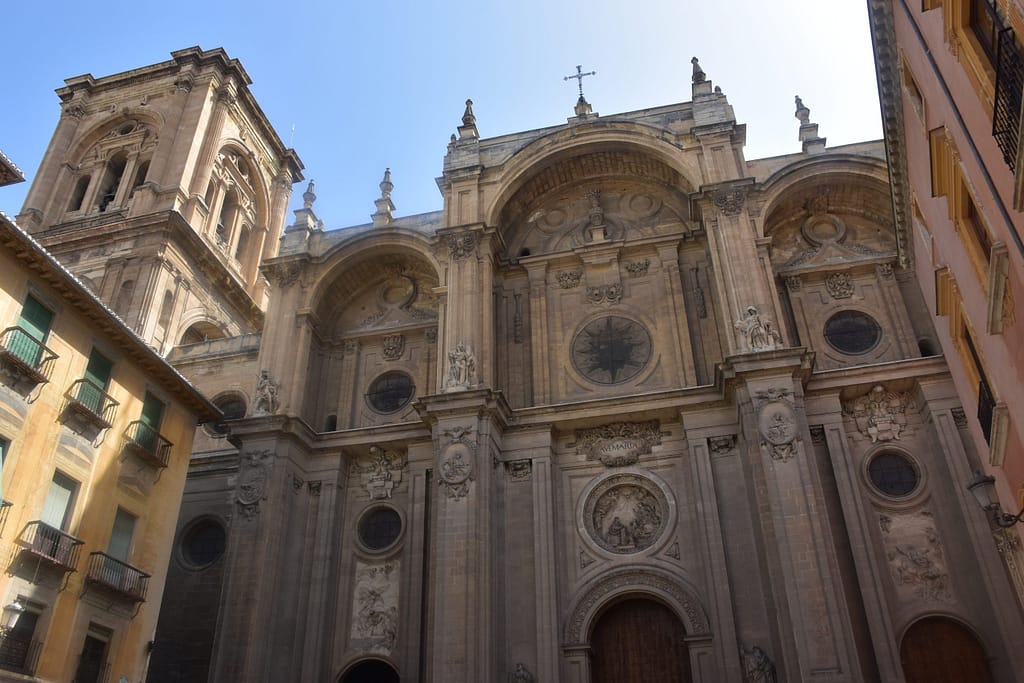
The most emblematic monument in the center of Granada is The Cathedral It is the greatest exponent of the city's Christianity. It was conceived by the Catholic Monarchs, although the project was not built until the reign of Charles V.
Its construction lasted 180 yearsDue to the lengthy period of its construction, an extraordinary fusion of architectural styles can be observed in it. Among them, we distinguish the gothic, baroque, neoclassical, and renaissance with the last one being the most important
Great masters, such as, participated in its construction Enrique de Egas, Diego de Siloé, Juan de Maeda y Alonso Cano.
The Cathedral Originally, it was planned that the building would have two twin towers, each eighty meters tall with four sections, according to Siloé's project. However, it ended up having a single tower of fifty meters with three sections due to unexpected cracks in the fourth section. Construction was halted, and part of the structure was dismantled, requiring reinforcement of the building's foundation.
In summary, the Cathedral of Granada Not only does it stand as an imposing symbol of Christianity in the city center, but it also serves as a living testimony to architectural mastery and perseverance throughout the centuries. Its construction, marked by the fusion of styles and overcoming unexpected challenges, makes it a unique monument that captures the historical and cultural richness of Granada. A place where faith, art, and dedication converge to offer visitors a fascinating and enriching experience.
The Royal Chapel
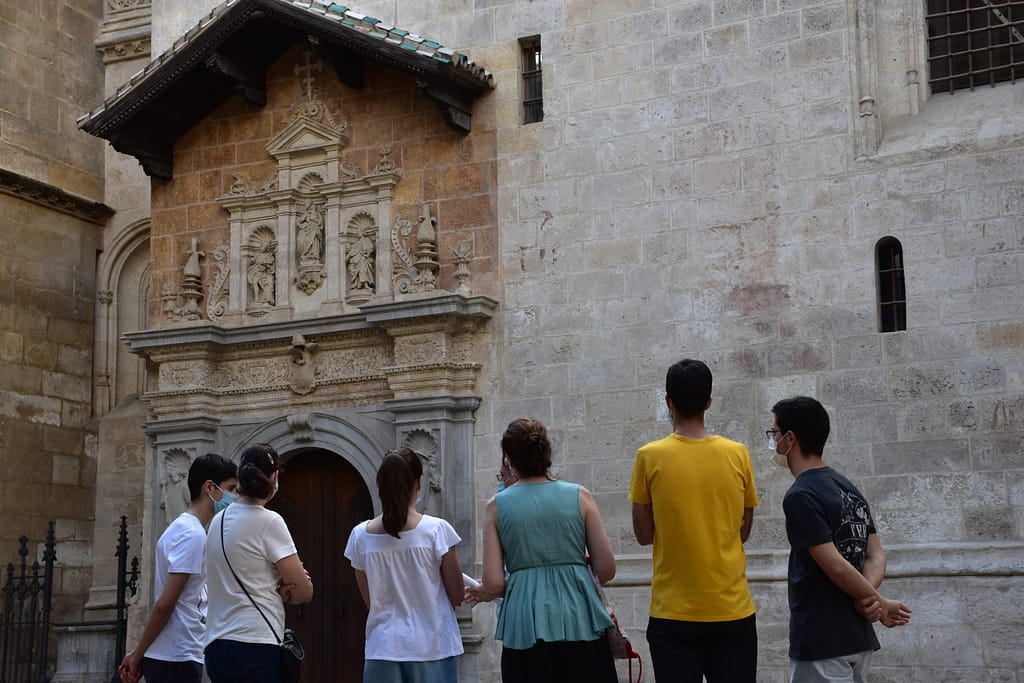
After visiting the Cathedral, you should approach the Royal Chapel . Here lie the bodies of the Catholic Monarchs, Isabel and Fernando. Also, those of their daughter Juana, her husband Felipe, and their grandson Miguel. This becomes a touching display of the love and significance that the Catholic Monarchs had for the city of Granada.
The first phase of construction of the Gothic-style Royal Chapel,was overseen by King Fernando between 1505 and 1517.
After his death, his grandson Charles I of Spain and V of Germany He assumed the leadership of the construction. The completion of the works and the transformation of the building into a Renaissance style were carried out during his reign.
It is interesting to note that the Royal Chapel was not completed when the monarchs passed away, leading to their bodies resting temporarily in the Parador de San Francisco until their final transfer to the Royal Chapel in 1521.
A journey to this place not only reveals architectural grandeur but also the intricate historical connection that binds these prominent figures to the city of Granada.
Madraza Palace
Next to the Royal Chapel is the “Madraza Palace” . This building was once an ancient Quranic school, constructed by Yusuf I. Only the Mihrab from the original construction remains, as everything else was reconstructed in the 18th century. The building served as the City Hall until 1851 when it was moved to its current location.
Church of the Sagrario
Continuing your journey down the street, you will come across the «Iglesia del Sagrario». This impressive structure completes the eastern profile of the Cathedral and has its roots in the former main mosque of the Muslim city. The mosque was demolished in 1704, and just a year later, work began on the construction of this new building.
However, due to financial limitations, the works were temporarily interrupted, and they resumed vigorously in 1717. The Church of the Sagrario finally opened its doors for worship On September 29, 1759.
This journey through the architectural history of Granada reveals the perseverance and dedication that have shaped these iconic places throughout the centuries.
The Alcaicería
Your next destination is the charming craft market. «La Alcaicería», an ancient Muslim silk market that housed over two hundred shops dedicated to the sale of silk and other goods. This vibrant bazaar extended from the Bib Rambla Square to Plaza Nueva., occupying a vast area.
In its days of splendor, The Alcaicería had ten access gates, guarded by guards and dogs. The history of its name has intriguing roots that go back to Emperor Justinian, who granted Arabs the exclusive right to the sale of silk. Among Muslims, the emperor was known as «qaysar», a word that evolved over time into the form currently known as Al-Qaysar o Alcaicería.
This craft market, steeped in history and tradition, invites you to immerse yourself in a unique experience where every corner tells the fascinating story of silk and ancient commercial transactions.
The Corral del Carbón
Continue your leisurely stroll until “The Corral del Carbón”, built by Yusuf I in the year 1336. This site was known as Alhóndiga Gidida or the new market. It served a dual purpose, functioning simultaneously as a warehouse for goods and as an inn, providing accommodation for merchants.
Access to this monument is through a single horseshoe arch doorway. Above it, you can read sura 112 of the Quran which recites:
God is one.
God is eternal
He neither begets nor is begotten.
Nor does He have any partner
The entire building was devoid of windows to the outside, thus avoiding continuous theft of merchandise. In charge was the 'alondiguero,' who lived in the rooms above the door. This person controlled the entry and exit of goods.
The only door of the building sealed tightly at sunset, depriving merchants of exiting until dawn. Before daybreak, they were notified so they could gather their belongings and animals. Only then were the doors opened, preventing anyone from taking something that didn't belong to them.

The Calderería
Now, your next destination is «La Calderería». Al avanzar por estas calles, te sumergirás en un festín de colores y aromas que emanan de bazares, comercios y teterías, transportándote a la esencia de los mercados árabes más tradicionales y exuberantes. Este animado rincón te invita a explorar la riqueza de la cultura local, donde cada callejuela cuenta una historia de tradición y autenticidad. Déjate llevar por la magia de «La Calderería» mientras absorbes la atmósfera vibrante que define la esencia de Granada.
Continuando con los lugares imprescindibles que debes conocer en el centro de Granada, anota en tu lista lo siguiente:
The Cuarto Real de Santo Domingo
The Cuarto Real de Santo DomingoDeclared a Cultural Heritage Site, the Cuarto Real de Santo Domingo is a monument of great historical-artistic value in the heart of Granada. Built during the reign of Muhammad II, it stands out as a direct precursor to the architectural solutions of the Alhambra. Although only the original tower with its qubba has been preserved, this space was part of a Nasrid royal residence with gardens and porticos. After the conquest of Granada, it passed into the hands of the Catholic Monarchs and later to the Dominican monks, who transformed the qubba into the first church of their convent. Currently rehabilitated, the Cuarto Real de Santo Domingo houses an Exhibition and Multipurpose Room, offering a dynamic cultural space that blends history and modernity.
The Casa de los Tiros
The Casa de los Tiros An ancient fortress from the 16th century located in the Realejo neighborhood, it stands out for its fortification appearance and its name, derived from the muskets that adorn the battlements. Originally acquired by the noble Granada-Venegas family, its facade displays the family crest and five notable statues: Hercules, Theseus, Jason, Hector, and Mercury.
Since 1921, the Casa de los Tiros has been owned by the State and transformed into a museum dedicated to the history of Granada. The twelve rooms house a rich collection spanning from the 16th century to the present, including drawings, engravings, newspapers, and photographs. The main staircase displays prominent royal portraits, while one room features 19th-century ceramics, Nasrid-influenced ceramics, and tapestries from prominent bourgeois families in Granada.
El punto culminante del museo es el salón conocido como la Cuadra Dorada, donde un techo de madera adornado retrata héroes españoles, bustos de reyes e inscripciones que narran sus hazañas. La Casa de los Tiros se erige como un tesoro histórico que ofrece una ventana fascinante a la rica historia de Granada.
The Public Laundry of Granada
The Public Laundry of Granada, located in Placeta Puerta del Sol, served the neighbors of the adjacent houses until the 19th century and is the only preserved laundry in the entire city. It stands out for its rectangular structure with a lintelled design, supported by six columns made of Sierra Elvira stone. This unique laundry was built with materials from the 17th-century Santa Escolástica church, although it was demolished in 1842. A historical relic that endures as a testament to communal use in the everyday life of Granada.
The Carmen of the Mártires
The Carmen of the Mártires, un oasis histórico a escasos metros de la Alhambra en Granada, es un cautivador jardín urbano con una rica historia. Esta casona del siglo XIX, rodeada de jardines botánicos, estatuas y un lago, fue testigo de diversas funciones a lo largo de los siglos, desde campo de justas en el siglo XI hasta ermita, convento y palacio. Llamado «Campo de los Cautivos» en la época de la Alhambra, las grandes mazmorras llegaron a albergar hasta 7000 prisioneros.
Over time, the site became the Carmen de los Mártires in memory of the Christian martyrs who perished. In the 19th century, the current summer residence was built, surrounded by exquisite gardens designed by Hubert Meermans. After years of neglect, the property has been restored and turned into a municipal public space. With free access, the Carmen de los Mártires offers a unique experience, perfect for strolling, relaxing, and enjoying various events. Immerse yourself in this historical oasis and discover the lesser-known side of Granada.
The Rodríguez-Acosta Foundation
The Carmen Blanco, or Rodríguez-Acosta Foundation, stands as a unique gem in Granada, blending art, architecture, and culture. Conceived as a compendium of modern styles for its time, this monument was meticulously designed by renowned architects such as Modesto Cendoya and Teodoro Anasagasti, with sculptural contributions from Pablo Loyzaga. In 1982, it was awarded the prestigious title of National Monument.
Located near the famous Alhambra, the Carmen Blanco stands out for its unique layout on various levels, adapting to the impressive slope of the terrain. Exploring this space unveils not only the main building that houses the library and studio of the painter José María Rodríguez-Acosta but also stunning gardens, courtyards, and viewpoints.
José María Rodríguez-Acosta, a Granada-born painter from an influential family in the history of Granada and Spain, left behind an exceptional artistic and cultural legacy. His life (1878-1941) was dedicated to his work, thanks to family prosperity. Beyond his fame for modernist works, between 1916 and 1930, he stopped painting to bring the Carmen to life, a place where his creativity and objects from around the world converge, giving the ensemble an original and exotic character.
The Rodríguez-Acosta Foundation, established in 1941, not only safeguards a valuable collection of historical artworks and archaeological objects but also stands out for its commitment to scientific research and cultural promotion. Rodríguez-Acosta's legacy is enriched by the family heritage and donations, shaping a museum space that captivates those who explore it.
With this list of essential places in Granada, we hope you can enjoy the monumental, cultural, and historical richness that this beautiful city has to offer. Have a wonderful trip!
 ENG
ENG  ES
ES 


