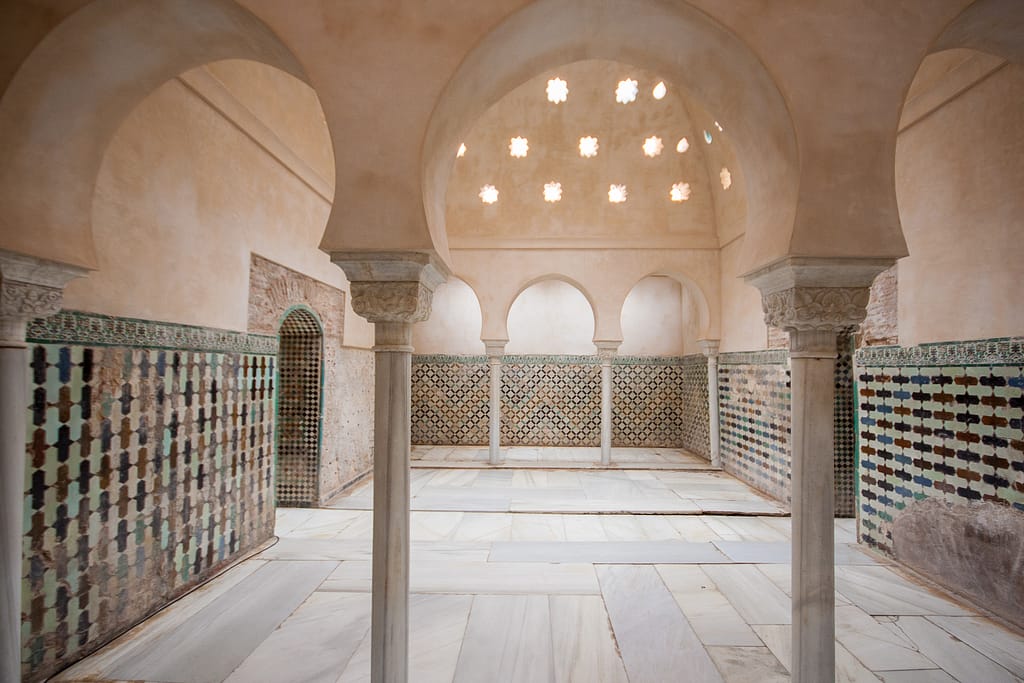
Hammam Granada
Sumérgete en la rica herencia a través de los Hammam Granada, donde la fusión de tradición árabe y bienestar se entrelazan para crear un santuario de relajación y cultura que ha dejado una profunda marca en el corazón de la península ibérica.
Water has been used by many cultures throughout history as a purifying element for the body. Regarding Islam, this precious and indispensable liquid is obligatory for purifying both the body and soul in unison. From this religious obligation arises the preference for the hammam, establishing itself as a fundamental element in the daily life of every Muslim.
The Arabic bath or hammam has its origin in the Roman baths with some modifications, which we will detail below.
The Hammam is divided into four main rooms:
First room: apodyterium or resting room
Second room: frigidarium or cold room
Third room: templarium or warm room
Fourth room: caldarium o sala caliente
How Does an Arabic Bath or Hammam Work?
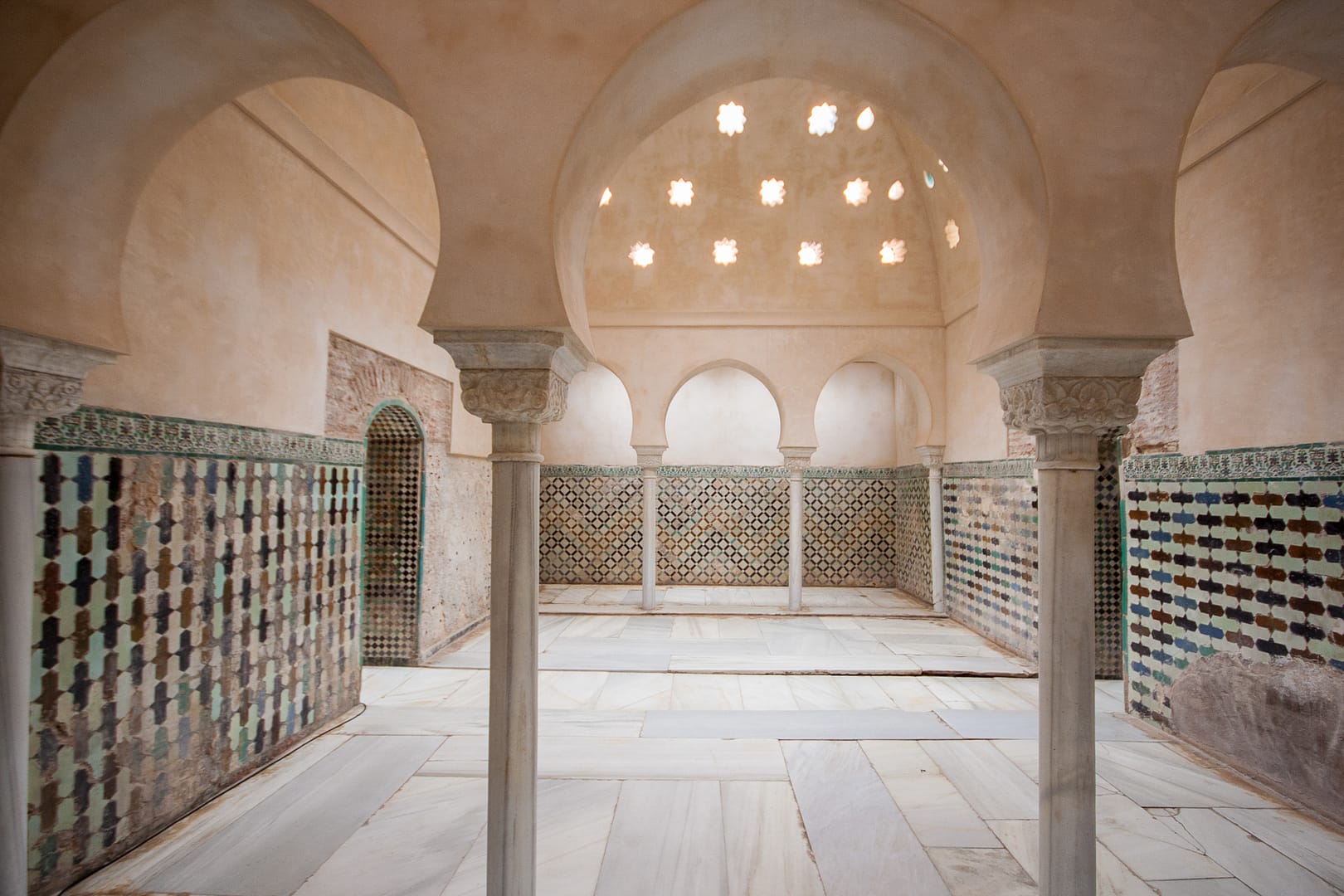
Over time, these spaces underwent a change in functionality. Initially, they served a primarily hygienic function. Later, they evolved into places of gathering and socialization, where politically and economically significant agreements were debated. The Arabic bath or hammam It was heated through the floor with a furnace or boiler. The floor was made of marble and received heat through underground pipes. This operation allows water thrown onto the floor to evaporate, producing steam. This type of space is now known as turkish bathThe ceiling was covered with domes and skylights that allowed light and air to enter. This way, the interior temperature could be controlled by opening and closing them. The last room is the hottest of all Hammam" o "baño árabeInside this room, there is the basin for immersion. It was heated through a furnace placed at the bottom, providing warmth to the floor. These baths also had boilers on the side walls to heat the water. It can be reasonably inferred that these rooms could reach temperatures of around fifty degrees Celsius. The high temperatures and steam promote skin cleansing and the removal of dead cells. These were eliminated using sponges made of horsehair or other animal hair. After the skin exfoliation, visitors would enter the immersion basin. After finishing the bath, they would return to the initial or resting room.
Arab Baths or Hammam in Granada
In Muslim Granada there were many Arab baths. After the Christian conquest, Queen Isabella I of Castile declared them impure places and ordered their destruction. Of the numerous baths that once dotted the city, only three have been preserved. "El Bañuelo" is the oldest bath in the city, dating back to the 11th century. It is located in the Lower Albaicín. It was not destroyed because it belonged to a noble. "El Baño de la Mezquita"is located next to the former main mosque of the Alhambra, now the church of Santa María de la Alhambra. Finally, we reference “el Baño de Comares”This is the only one preserved in the Nasrid Palaces because it was the private bath of Queen Isabella I of Castile. Granada offers you the wonderful opportunity to enjoy a relaxing Arabic bath or hammam in some establishments open to the public in the city. Indulge in a bath of history! Are you up for it? You are in the right place.
We offer you the following alternatives at unbeatable prices.
A very spacious bath with a large number of pools at different temperatures.
You will be able to enjoy the following services in it:
- Only Bath
- Bath + 15-minute Massage
- Bath + 30-minute massage
The duration of the bath, including the massage, is 1 hour and 30 minutes.
This bath will be fabulous for both you and your wallet.
We make it easy for you. Just contact us and we'll be happy to assist you.